
COIN COLLECTING · 4 MIN READ + VIDEO
Can You Spot the Silver Hiding in Your Loose Change?
Play three coin-checking rounds before cashing in change: a dime date, a half-dollar exception, and a clue on the back of a nickel.
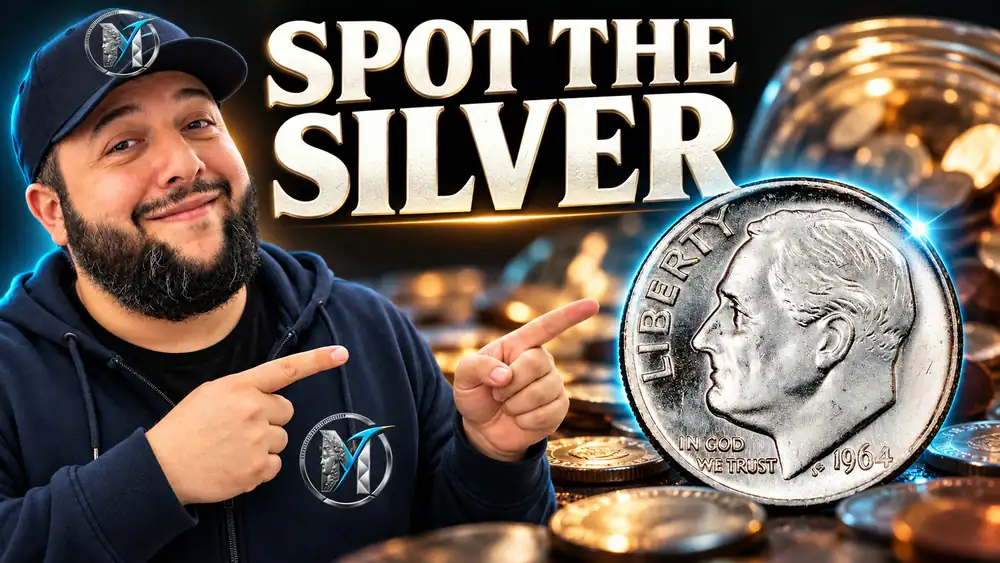
Before a jar of change goes into a counting machine, there is a better question than how much it weighs: have you identified what is in it?
Play the video first and keep a score out of three. You will choose between two Roosevelt dimes, decide what to do with a 1967 Kennedy half dollar, and look for a detail on the back of a wartime nickel. Each round reveals the clue after you make your pick.
The coins are reference examples, not a claim that we just found them in a jar. The aim is a useful sorting habit, not a jackpot promise. The explanations below contain the answers.
THREE ROUNDS · KEEP YOUR SCORE
Play the silver challenge
Watch on YouTube ↗Reference-image credits and licenses are included in the film and its YouTube description.
Read the video transcript
Stop. Before that change goes into a counting machine... which of these would you pull out? Two dimes. Same face value. But the detail that changes the answer is right there on the coin. We're playing three rounds. First, the date. Then a half dollar that breaks the rule you just learned. And finally, a nickel with a clue on the back. Keep your own score. These are reference examples, so we're checking the coins, not claiming a lucky find. Round one. A 1964 Roosevelt dime... and a 1965 Both say one dime. Both have Roosevelt on the front. Which one belongs in our silver-check pile? Pick one before the reveal. 1964 That ordinary circulation Roosevelt dime was made with 90% silver. The normal 1965 circulation issue is copper-nickel clad. One year changed the material, even though the familiar design stayed. Look at the date again. You're not looking for the shiniest coin. You're identifying an issue. Wear, tarnish and lighting can change how a surface looks. A polished coin isn't automatically silver, and a dull one isn't automatically something to throw back. For circulation Roosevelt dimes, 1946 through 1964 is the 90% silver range. That same 1964 cutoff is useful for the familiar Washington silver quarters. But don't turn it into a rule for every denomination. The next round is exactly why. If that already made you look at your change differently, hit like and subscribe to NumisTrends. We get the coin under the camera, show you the detail, and explain why it matters. Now... let's see if I can catch you with round two. This Kennedy half dollar is dated 1967 Keep it in the silver-check pile... or pass? Remember, it's after 1964 Look at the actual date. What would you do? Keep it. 1967 Kennedy halves contain 40% silver. That's the trap: 1964 wasn't the end of silver for these half dollars. The normal issues from 1965 through 1970 still used silver, just a lower proportion. Here's the short version. 1964 Kennedy: 90% silver. 1965 through 1970 40% In 1971 the normal circulation composition changed to copper-nickel clad. Same denomination. Different date ranges. That's why we check the exact issue. You may hear, Just look at the edge. An exposed copper-colored core can be a useful sorting clue on ordinary clad coins. But colour alone does not prove composition or authenticity. Don't let a quick shortcut replace the date, the denomination and a reliable reference. And if you're looking at a proof, a special collector issue, an altered coin or something genuinely unusual, slow down. Some later collector coins were made in silver too. We're learning a first sorting pass for familiar circulation issues, not declaring every later coin ordinary. Final round. Five cents. You're looking at the back of a wartime Jefferson nickel. Where would you look first: the building, the words five cents, or that big letter above the dome? Pick the detail that changes the composition check. That big mint mark. On the reference coin it's a P, above Monticello. The wartime alloy used from part of 1942 through 1945 contained 35% silver. It wasn't the usual nickel alloy, despite what we call the coin. For this wartime series, look for the large P, D or S above the building. And here's the detail people skip: not every 1942 nickel used the silver alloy. That was a changeover year. The date alone doesn't finish that identification. A matching date and mint-mark layout tells you what issue you're looking at. It doesn't authenticate an unknown coin. If something doesn't match, keep it separate and check it properly. The point is to stop a quick cash-out from becoming a rushed decision. So... how many did you get? The 1964 dime. The 1967 half dollar. And the big mint mark on the wartime nickel. Three different clues. Three reasons a quick glance at the face value can miss part of the story. Before cashing in change, make three piles: identified ordinary change, pieces worth another look, and anything you haven't identified. Check both sides. Photograph the date and mint mark. Use a dependable reference, and don't polish a coin just to make it look valuable. Finding silver content isn't the same as getting a particular cash offer. Condition, the exact issue, market prices and a buyer's terms still matter. And no, this doesn't mean every jar has a hidden winner. It means you know what to check before you let it go. Tell me which round caught you: the dime, the half dollar, or the nickel. And if this was useful, subscribe for more coin checks with the details shown, not just a big number in a headline. Now go look at that change with a better question.
In this guide 5 sections + questions & sources
Round one: same face value, different material
An ordinary 1964 Roosevelt circulation dime contains 90 percent silver. The normal 1965 circulation issue is copper-nickel clad. Both carry a ten-cent denomination and the familiar Roosevelt design, so the date matters more than a quick impression of brightness.
For ordinary circulation Roosevelt dimes, 1946 through 1964 is the 90 percent silver range. That is a useful first check for this series. It is not a rule for every denomination, and a date alone does not authenticate an unknown coin.
Can You Spot the Silver Dime? Don't Use This Rule for Every Coin
Watch on YouTube ↗Reference-image credits and licenses are included in the film and its YouTube description.
Read the video transcript
One of these Roosevelt dimes is 90% silver. The other ordinary circulation issue is copper-nickel clad. Which would you keep for a closer look? 1964 is the silver one. But don't use that cutoff for every coin: our half-dollar round breaks it. Can you beat all three rounds? Tap the related video below our channel name to play the full challenge. Like the tip, and subscribe for more coin details worth a closer look.
Round two: the half dollar that breaks the shortcut
The 1967 Kennedy half dollar in the video belongs in the silver-check pile. Normal Kennedy issues from 1965 through 1970 contain 40 percent silver, rather than the 90 percent composition of the 1964 issue.
The normal circulation composition changed to copper-nickel clad in 1971. Applying a blanket “nothing after 1964” rule would miss this half-dollar group. Later special collector issues need their own exact-issue checks too.
Can You Spot the Silver in This 1967 Half Dollar?
Watch on YouTube ↗Reference-image credits and licenses are included in the film and its YouTube description.
Read the video transcript
After 1964 no more silver? Hold on. This 1967 Kennedy half dollar contains 40% silver. The normal 1965 through 1970 issues did too. One shortcut could make you pass over it. Now try the full challenge: a dime, this half dollar, and a nickel with a clue on the back. Tap the related video below our channel name to play the full challenge. Like the tip, and subscribe for more coin details worth a closer look.
Round three: turn the nickel over
On the wartime Jefferson nickel reference, look above Monticello for the large mint mark. The 1945-P example shows a prominent P. The wartime alloy used from part of 1942 through 1945 contained 35 percent silver.
For this wartime series, the large P, D or S above the building is an important identification detail. 1942 was a changeover year: not every 1942 nickel used the silver alloy. Read both sides rather than stopping at the date.
A sorting clue is not an authentication result
An exposed copper-colored core can help you sort familiar clad coins, but surface color, an edge or a matching date does not prove authenticity. Wear, tarnish, lighting, alterations and special issues can complicate a quick look.
Keep anything you have not identified separate. A reference tells you what an issue should be; it does not establish that an unknown specimen is genuine. Silver content also does not guarantee a particular cash offer. Exact issue, condition, market prices and a buyer's terms remain separate questions.
Before you cash in the change
Which round caught you: the dime, half dollar or nickel? Tell us your score in the YouTube comments. If the challenge helped you see a detail you would have missed, like the video and subscribe to NumisTrends for more close-up coin checks.
- Make separate piles for identified ordinary change, pieces needing another look, and unidentified coins.
- Check both sides and photograph the date and mint mark clearly.
- Use a dependable reference for the exact issue; do not apply one denomination's cutoff to every coin.
- Keep holders and packaging, and do not polish coins to make them appear valuable.
COLLECTOR FAQ
Questions worth asking
Are all coins dated after 1964 clad?+
No. Normal Kennedy half dollars from 1965 through 1970 contain 40 percent silver. Later special collector issues also require their own composition checks.
Are all 1942 Jefferson nickels silver?+
No. 1942 was a changeover year. Check the correct wartime mint-mark arrangement and a dependable reference for the exact issue.
Does a silver-colored edge prove a coin is silver?+
No. An edge or surface color can be a preliminary sorting clue. It is not proof of composition or authenticity.
NumisTrends provides educational information, not financial, legal, tax, grading, or appraisal advice. Verify the exact item and current market before a transaction.