

Gemstones · 5 MIN READ
What a Gemstone RI Reading Can—and Cannot—Tell You
Read refractive-index results as evidence, with attention to contact, precision, instrument range and the part of the stone actually tested.
In this guide 6 sections + questions & sources
Start with the question the instrument actually answers
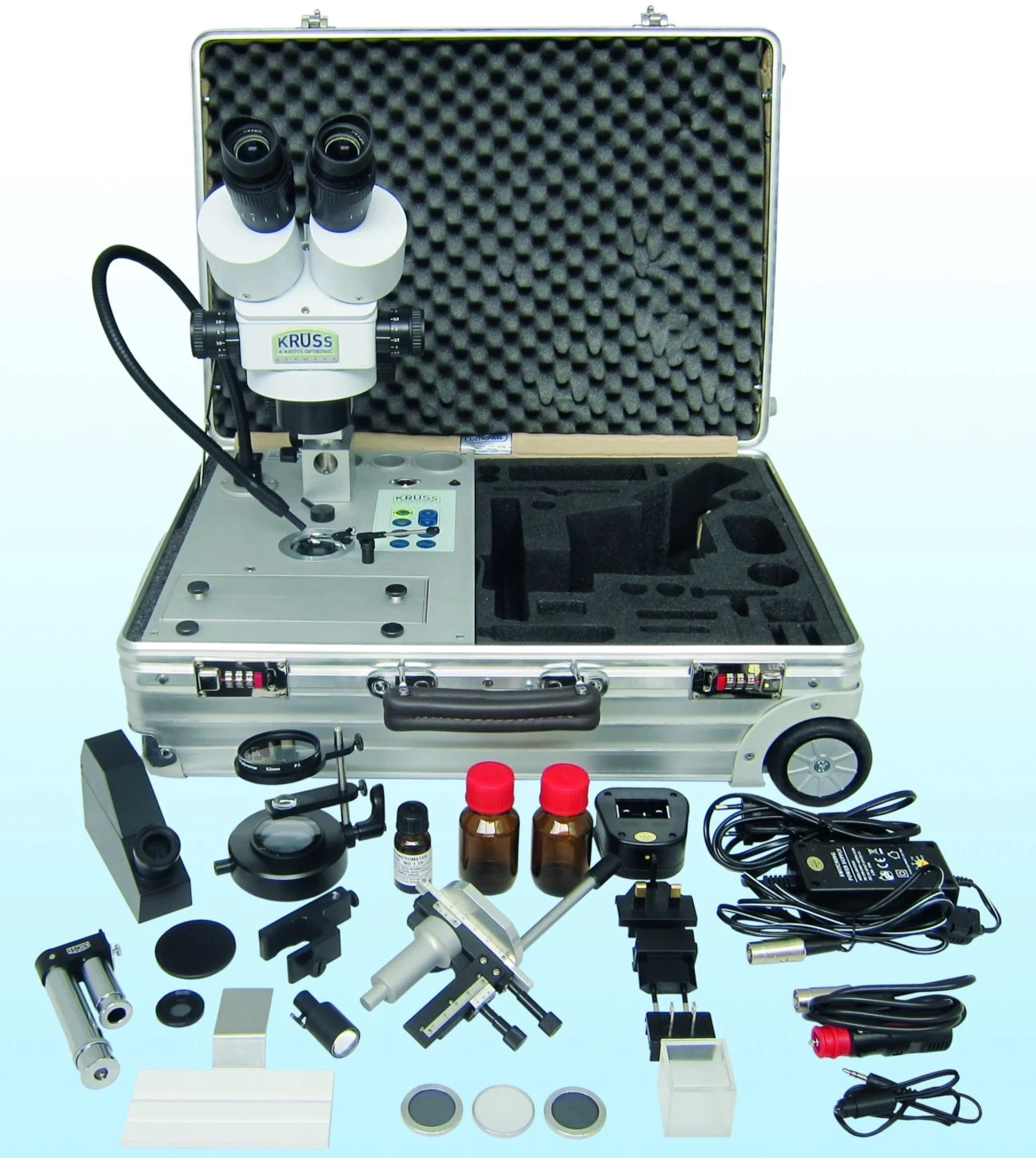
Refractive index, usually shortened to RI, describes an optical property of a material. A conventional gemological refractometer obtains information from light behavior at the contact between the stone and the instrument. It does not read a hidden label saying natural sapphire, untreated emerald or country of origin. That distinction matters when a seller presents one convincing-looking decimal as a complete explanation.
Gem-A describes refractometry as useful for finding minimum and maximum RI values, investigating optical character and calculating birefringence. Those are meaningful observations when the method is suitable. For a buyer, the first useful question is therefore not simply what number appeared. Ask which surface was tested, what procedure was used and what conclusion the operator believes that procedure can support.
Precision belongs to the method, not the display
A readable polished facet and a rounded cabochon do not necessarily offer the same kind of measurement. A spot result should remain a spot result in your notes. Do not add decimal places because a reference table has more of them. Likewise, a broad or unstable boundary should not be transcribed as a sharp, repeatable reading.
Keep the original notation when comparing information. Approximately 1.54 is not interchangeable with a carefully established pair of limiting values merely because they begin with the same digits. In a fictional notebook, write 'spot RI approximately 1.54; contact limited by curved surface' rather than 'RI 1.540, identity confirmed.' The first entry preserves uncertainty; the second invents both precision and a conclusion.
Over the limit is different from no usable reading
Every instrument and contact-liquid combination has a working range. Gem-A's conventional refractometer documentation describes a range ending around 1.81, but that is not a universal limit for every optical instrument. An over-the-limit result means the particular setup cannot directly resolve the value. It does not supply the missing number or identify a single high-RI material.
A missing or poor reading can also reflect unsuitable contact, surface condition, access or technique. Keep 'no usable reading obtained' separate from 'confirmed over the instrument's limit.' If you are not trained to distinguish those outcomes, request professional testing instead of selecting the most exciting candidate from a chart. Never experiment with unknown contact fluids or expose an unidentified, porous or assembled object to them without competent guidance.
A measurement may describe only one component
In a 2025 GIA laboratory case, a green mounted object gave a spot RI around 1.54. That helped point the examination toward quartz rather than establishing emerald from its color. Raman spectroscopy and further inspection followed. The object proved to contain quartz components joined with green cement. The early optical result was useful precisely because it was treated as one stage in a larger investigation.
This makes a good reading exercise. Imagine receiving a single RI number for an attractive pendant. Before accepting it as a description of the whole object, ask whether the crown, backing and any joining layer were considered. A genuine reading from one accessible surface need not explain a concealed lower component. A mount can limit access without announcing that limitation in the seller's headline.
Overlap is a reason to continue, not force a match
Different materials or material categories can have overlapping measured properties. GIA's comparison of modern and fossil ivories found overlapping spot RI and specific-gravity results; those observations could not distinguish the two categories. That example is not an invitation to test or trade ivory. It demonstrates the narrower point that matching a reference interval does not automatically select one identity.
Use a candidate list as a record of possibilities, not as a popularity contest. If three possibilities fit the limited data, retain three until a suitable observation separates them. Do not average incompatible readings until they happen to match a desired name. A result that disagrees with the proposed identity deserves explanation, but agreement by itself does not prove natural growth, lack of treatment or geographic origin.
Turn the reading into a useful request
The most useful next step is a short measurement record that another person can evaluate. Preserve what was actually observed, where it was observed and which parts remain untested. If a purchase depends on natural versus laboratory-grown origin, treatment status or a valuable variety designation, request testing that addresses that exact question.
Use this checklist before relying on an RI claim. It is deliberately a documentation checklist, not a liquid-handling or identification protocol.
- Identify the instrument and whether the value was a facet reading, spot estimate or other method.
- Record the tested surface, mounting restrictions and any assembly concerns.
- Retain approximate signs, intervals and repeatability notes instead of adding precision.
- Ask which independent evidence supports the stated identity and which questions remain unanswered.
- Keep an inconclusive reading inconclusive until appropriate further examination is available.
COLLECTOR FAQ
Questions worth asking
Does a higher RI mean a more valuable gem?+
No. RI is an optical property, not a price scale. It does not by itself establish the material's identity, natural origin, treatment status, condition or desirability.
Can matching a published RI prove a stone is natural?+
No. A match is consistency with a property, not proof of growth history. Natural and laboratory-grown counterparts can have closely similar optical properties.
Should I ask for a second reading?+
Ask for a suitable repeat examination and its limitations, not just another number. If the surface or method is unsuitable, repeating the same inadequate measurement may not resolve anything.
PRIMARY SOURCES
Verify the details.
Gem-A Instruments: Refractometers and Accessories ↗Gem-A Instruments History, Gems & Jewellery 28(4), 2019 ↗GIA: Quartz Assemblage Imitating Emerald (2025) ↗GIA: A Comparison of Modern and Fossil Ivories Using Multiple Techniques (2013) ↗GIA: An Introduction to Synthetic Gem Materials ↗KEEP LEARNING
Take the next step.
Explore the gemstone reference →Understand treatments and laboratory reports →Browse all collector articles →NumisTrends provides educational information, not financial, legal, tax, grading, or appraisal advice. Verify the exact item and current market before a transaction.