
COIN COLLECTING · 4 MIN READ + VIDEO
Franklin Half Dollars: Silver Weight and Full Bell Lines Are Different Checks
A Franklin half has a published silver weight. Full Bell Lines asks a different question about the reverse. Use this short lesson to keep the calculation and the designation separate.
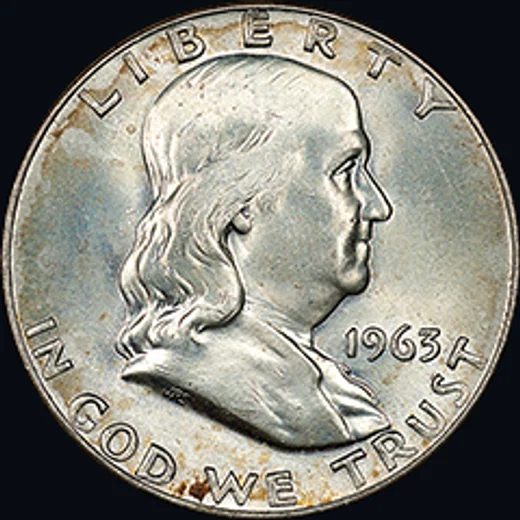
A recognizable bell and a silver-content figure answer different questions. Mixing them up can turn a useful metal calculation into an unsupported claim about a particular coin.
Watch the short Franklin lesson, then check the inputs and the reverse details separately. The photographs illustrate a coin type; this article does not grade, authenticate or offer the pictured coin.
COIN IDENTIFICATION · SHORT LESSON
Watch the Franklin half-dollar check
Watch on YouTube ↗The reference-photograph section below identifies the photographer, license and changes. The pictured obverse does not show the bell lines.
Read the video transcript
Seeing the Liberty Bell does not prove Full Bell Lines. A Franklin half's silver weight is one question; strike quality and collector value are another. This profile contains zero point three six one six nine fine troy ounce of silver per coin. Ten matching coins contain three point six one six nine fine troy ounces. Multiply that total by the current silver spot price. Purity is already included. The exact issue and condition still matter for collector value. Choose the exact coin at NumisTrends dot net.
In this guide 4 sections + questions & sources
Start with the silver content, not a designation
For standard Franklin halves dated 1948 through 1963, NGC lists 12.5 grams total weight and 0.36169 fine troy ounce of silver. That fine-silver figure already accounts for the 90 percent alloy. It is not the total coin weight in troy ounces.
Use the exact coin profile and the number of matching coins. Ten × 0.36169 gives 3.6169 fine troy ounces. Multiply that quantity by a silver price quoted per troy ounce to estimate contained metal value. Do not apply the 90 percent purity a second time.
That result describes metal content at the chosen price input. It does not establish a buyer’s offer, a coin’s grade or its collector premium.
What PCGS means by Full Bell Lines
PCGS applies its Full Bell Lines designation to qualifying Franklin halves graded MS 60 or higher. Its criteria concern separation of the lower horizontal lines on the reverse bell and significant interruptions from marks or cuts. Seeing the bell design is not the same check.
Use a clear reverse view to identify what needs closer inspection. The obverse reference photograph on this page cannot show the required lines. The lesson makes no FBL determination about that photographed specimen.
For a certified coin, read its actual label and the criteria of the service that issued it. A photograph, a calculator result and a familiar date each have a different evidential limit.
A practical two-part check
First, identify the denomination, issue and quantity for the metal calculation. Next, inspect the coin’s condition and relevant design details separately. Record an uncertain designation as a question to investigate, not a label to apply.
Open the Franklin calculator profile to review the silver quantity, and use the complete identification guide and lesson transcript for context. For more close-up coin checks, use the player’s Watch on YouTube link to visit NumisTrends.
- Confirm the exact issue before choosing a calculator profile.
- Keep fine troy ounces separate from total grams and face value.
- Photograph both sides; an obverse image cannot demonstrate reverse bell lines.
- Keep any grading-service designation separate from the melt calculation.
About the reference photograph
The image shows the obverse of a 1963 Franklin half dollar. The source credits the photograph to John Baumgart of Variety Slabbing Service. The photograph is available under CC BY-SA 3.0; the public-domain coin-design notice is separate.
The website reference has been cropped, resized and placed on a square field. The image derivative retains CC BY-SA 3.0. It is a representative reference, not sale inventory or a photo showing Full Bell Lines.
COLLECTOR FAQ
Questions worth asking
Does Full Bell Lines change the published silver weight?+
The silver-content calculation uses the issue’s metal specification. Full Bell Lines is a separate designation concerning design detail and qualifying condition; it is not an extra amount of silver.
Should I multiply 0.36169 by 90 percent again?+
No. The figure is already fine silver in troy ounces. Apply the quantity of matching coins, then a price in the same per-troy-ounce unit.
Can the obverse photograph prove Full Bell Lines?+
No. The relevant lines are on the reverse bell, and the image on this page shows the obverse. This article assigns no grade or designation to the reference coin.
PRIMARY SOURCES
Verify the details.
NGC: U.S. silver coin melt-value specifications ↗PCGS: Full Bell Lines on Franklin half dollars ↗NumisTrends provides educational information, not financial, legal, tax, grading, or appraisal advice. Verify the exact item and current market before a transaction.