
SILVER COIN FIELD GUIDE
Is my Eisenhower dollar silver?
An S mintmark is a clue. The exact issue decides whether the coin belongs in the silver calculator.
The short answer
The regular 40% silver collector issues are 1971-S, 1972-S, 1973-S, 1974-S and the dual-dated 1776–1976-S, in proof and uncirculated finishes. Some of those dates also have S-mint clad proofs. Confirm the issue before counting its silver.
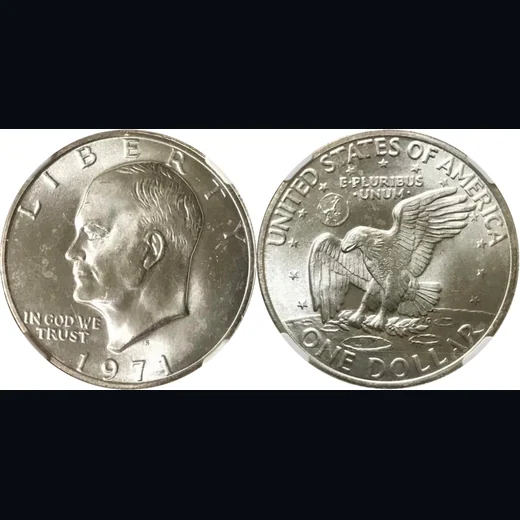
The metal baseline
- Profile covers
- 1971–1976 silver issues
- Composition
- 40% silver
- Standard gross weight
- 24.59 g
- Fine silver per coin
- 0.3161 troy oz
- Face value
- $1.00
Dates and composition at a glance
| Issue | Composition | Check before calculating |
|---|---|---|
| 1971-S and 1972-S regular collector issues | 40% silver | Proof and uncirculated. |
| 1973-S and 1974-S | Silver or clad, depending on issue | 40% silver proof/uncirculated editions; copper-nickel clad proofs also exist. |
| 1776–1976-S | Silver or clad, depending on issue | 40% silver proof/uncirculated editions; copper-nickel clad proofs also exist. |
| Regular Philadelphia and Denver issues; regular 1977–1978 issues | Copper-nickel clad | Rare wrong-planchet errors such as 1974-D and 1977-D are a separate authentication question. |
Check the date, mintmark and issue together
Find the date and mintmark, then read any original packaging or certification description. A loose 1973-S, 1974-S or 1776–1976-S proof needs an additional composition check: both clad and silver versions were made.
There is no regular 1975-dated Eisenhower dollar; the Bicentennial coins carry 1776–1976. Ordinary 1977 and 1978 dollars are copper-nickel clad. Rare wrong-planchet errors require expert authentication, not a guess from color.
References: PCGS — Complete silver Eisenhower set composition ↗ · PCGS — Eisenhower major-variety set composition ↗ · PCGS — The 1977 Eisenhower Dollar ↗
Compare two 1973-S dollars
PCGS lists the 1973-S clad proof at about 22.7 grams and the silver issue at about 24.6 grams. Their shared date and S mintmark do not make them the same product.
Weight can help screen an already loose coin, but it does not authenticate one. Do not break a sealed holder to weigh it. Match the documented issue and finish; if the evidence conflicts, leave composition unconfirmed and seek an experienced review.
References: PCGS CoinFacts — 1973-S clad proof Eisenhower ↗ · PCGS CoinFacts — 1973-S silver Eisenhower ↗ · U.S. Mint — Caring for Your Coin Collection ↗
Use the silver calculation only after identification
A standard 40% silver Eisenhower contains approximately 0.3161 fine troy ounce of silver. Multiply the confirmed quantity by that amount and a current silver quote.
The result is a contained-metal estimate. It does not price a proof, a better-preserved coin, an attributed variety or a genuine mint error. Keep those questions separate.
References: NGC — U.S. silver coin melt specifications ↗
Put that idea to work.
Your dollar is a 1973-S proof. What should you check before using the silver calculator?
No score, no penalty. Use the explanation and try again.
Questions collectors ask
Does an S mintmark mean an Eisenhower dollar is silver?
No. For example, PCGS documents a 1973-S copper-nickel clad proof. Read the exact issue, not just the mintmark, before selecting the silver profile.
Is a 1776–1976 Eisenhower dollar silver?
Some are. The S-mint 40% silver collector editions exist alongside copper-nickel clad Bicentennial dollars, including S-mint clad proofs. The date or Bicentennial design alone does not decide the composition.
Can I identify a silver Eisenhower by weight alone?
No. A standard silver issue is about 24.6 grams; a clad example is about 22.7 grams. Use weight as a supporting check for a loose coin, together with the issue, finish and records. It is not proof of authenticity.
Silver Eisenhower Dollar
Read the transcript and credits
- An S mint mark does not prove an Eisenhower dollar is silver. Selected collector issues contain forty percent; ordinary circulation coins and some S proofs are clad.
- This profile contains zero point three one six one fine troy ounce of silver per coin.
- Ten matching coins contain three point one six one fine troy ounces. Multiply that total by the current silver spot price.
- Purity is already included. The exact issue and condition still matter for collector value.
- Choose the exact coin at NumisTrends dot net.
Photographs resized and cropped for display; coin details are not retouched. Windrain · CC0 1.0 · License.
Music: “I Found the Grade in the Lighting” by NumisTrends.
An S does not automatically mean silver
A 1973-S clad proof and a 1973-S silver uncirculated dollar can share the year and mintmark while differing in composition and finish. Identify the actual issue before using this 40% silver profile.
Packaging can help establish what was originally sold, but a loose coin still needs its own identification. Do not treat every Eisenhower dollar from 1971–1976 as a silver coin.
Where to look. Check the issue and finish against a reference. For example, a 1973-S clad proof has an S but does not belong in this silver calculator profile.
Dates and details worth a second look
This is a selected watch list, not every key date or variety in the series. Finding a matching date is a reason to inspect further—not proof of authenticity, grade, or a particular value.
What do these collector labels mean?
Better date. A date or issue that merits its own comparison, not an automatic high-value finding.
Condition rarity. Scarce in a particular grade or strike designation, even if worn examples are available.
Variety. A specific attributed design or die difference, not every coin with that year.
- Better date
1973-S silver uncirculated
A lower-mintage silver collector issue, separate from the clad proof.
Check the attribution reference ↗ - Condition rarity
1971-S silver uncirculated
Unusually clean examples merit closer grading. Ordinary examples of the date are common.
Check the attribution reference ↗ - Variety
1971-S/S RPM FS-501
A repunched mintmark on the silver uncirculated issue; attribution is required.
Check the attribution reference ↗
Two questions, not one price
What is the contained metal worth? This profile uses 0.3161 fine troy ounces of silver per coin. Multiply that by the number of matching coins and a current per-troy-ounce silver quote. The calculator shows the quote and its freshness when available.
What might a collector pay for this coin? That takes the exact issue, condition, surfaces, finish, and any authenticated variety. The checkpoints above explain why a collector sale may differ from the metal estimate. A calculated melt value is neither a guaranteed buying offer nor a complete appraisal.
The listed weights are standard reference specifications, with rounded published fine-metal values. They do not measure wear, damage, missing metal, or authenticity in your individual coin. Gross grams include the alloy; fine troy ounces describe the precious metal itself.
Calculate a confirmed 40% silver Eisenhower →Build a useful comparison
- Record the full date, mintmark, denomination, and finish. Photograph both sides and any diagnostic detail.
- Use the specific references above to check a suspected variety. Do not clean the coin to make a feature easier to see.
- Compare completed sales for the same issue and similar condition. Separate proof, special-strike, and attributed examples from ordinary coins.
- Record shipping and other costs separately. An asking price or one exceptional auction result is not a typical sold price.
References and further checking
Use these references to inspect the issue and attribution in more detail. Prices, populations, and market premiums can change.
- NGC — U.S. silver coin melt specifications ↗
- PCGS — Complete silver Eisenhower set composition ↗
- PCGS — Eisenhower major-variety set composition ↗
- PCGS CoinFacts — 1973-S clad proof Eisenhower ↗
- PCGS CoinFacts — 1973-S silver Eisenhower ↗
- PCGS — The 1977 Eisenhower Dollar ↗
- PCGS encyclopedia — 1974-D Eisenhower wrong-planchet error ↗
- U.S. Mint — Caring for Your Coin Collection ↗
- 1973-S silver uncirculated — reference ↗
- 1971-S silver uncirculated — reference ↗
- 1971-S/S RPM FS-501 — reference ↗
- NGC silver melt-value reference ↗
Educational reference only; not individualized appraisal or investment advice. For a potentially valuable or questionable example, use a qualified numismatist or established authentication service.
Keep the look-alikes straight
Browse all 34 coin guides →
YOUR NEXT STEP
Have coins of your own?
Use what you have learned to describe your collection and request a private sale or consignment review.